Between Dirt and Starlight: On Grief and Fatherhood
Written by Matthew R. Manning
Photography by Priscilla Gragg
Alice.
15 years before you were born, I sat atop the world, draped in stars on the ledge of a hundred-foot water tower in an isolated Ghanaian village.
For six weeks, my friends Lea, Jessie and I had peered up at the tower from a patio across the red-dirt road. As the bronze sun fell behind the earth, we talked about life, about loss and regret, love and family. I talked about you, about the children I imagined someday filling my world with color.
The water tower we gazed upon during these golden-hour discussions was the highest point in town. It became a symbol for all things greater than ourselves—the mountain we hoped to climb.
In our seventh week in N’kwanta, under the cover of night, we finally climbed it.
Feet dangling and stomachs tight with adrenaline, we sat at the tower’s edge, suspended between dirt and starlight, and embraced the grandeur of the sky.
Then, without warning, the world went dark. The warm glow of streetlamps that illuminated the village disappeared in a blink—a massive power outage.
We could see nothing, not even our own hands, save for a few flashlights bobbing on the road far below.
Darkness folded itself around us; fear soon followed.
Will we be ok? How do we get down? Can we safely move through what we cannot see?
Our carefree musings on audacious futures were snuffed out by an urgent, immediate dread. We had no choice but to sit still. To slow our breathing and surrender to the darkness.
Then, the unexpected happened. Slowly, our eyes adjusted. And everything masked by darkness began to glow.
Without the veneer of artificial light, a vast universe appeared. Stars emerged by the millions. Blue, white, yellow and purple bands of light danced across the Milky Way. Familiar constellations like Ursa Major and Ursa Minor lay sideways along the horizon, as though the entire sky had been toppled over. Occasionally, a star rocketed across the sky, faster than a blink.
High above the trees, with nothing between us and the cosmos, I felt hugged by the universe.
An all-consuming blackness had made way, through the quieting of distractions, to the most masterful display of light I’ve ever seen.
This is the best language I have, Alice, to explain my journey into fatherhood—and my journey to you.
✦
I always believed I was meant to be a father. I recall an autumn walk with your Oma around Lake Harriet in Minneapolis when I was a teenager. We passed a young dad pushing a stroller with one hand and walking his dog with the other. My mom hooked her arm around mine, leaned in, and said, “That’s what you were born for. Someday you will make a great papa.”
I carried those words for two decades. Fatherhood, like that water tower, was the mountain I wanted to climb.
I never considered that reaching it might demand a harrowing journey through grief. That I would have to find light anew.
When your older sister Etta Mae was born, your mama and I knew instantly that everything that came before was an overture. The birth of Etta, our first child, made us whole. As we lovingly cared for her, she healed us.
But three months later, after a cascade of complications from an illness her doctors still cannot explain, Etta died.
Our lights went out. Your sister was the sun we orbited, and her death thrust our galaxy into shadow and disarray—a massive power outage.
Your mama and I could see nothing. There were moments we thought, even wished, our lives had ended.
Grief formed a black hole around us, a vacuum of time and space, creating an inward pressure so immense we could do nothing but succumb.
What happens when your child becomes an angel? Do they become an ancestor? Do you remain the guide, or become the guided?
During Etta’s final days in hospice, your mama and I did the only thing we knew how: we surrendered to the darkness. And in time, as with the water tower, our eyes adjusted. Heedfully, we made a home.
We warmed Etta’s sterile hospital room with string lights, like twinkling stars, and turned off the harsh overhead lighting. We filled the windowsill with bouquets of eucalyptus and wildflowers. We fetched our comfiest clothes and a portable kettle to boil tea. We had Oma bring Etta’s favorite toys and books, and our small blue rug from home, and laid them beside our conjoined hospital beds. We laughed. We cried. We read together. We played board games and filled the space with music. We talked about our family and future. We surrounded your sister with warmth as life slowly left her earthly form. Together, we became light.
We could not save Etta. But we could make certain that, for every moment she remained here, she knew love. We could permanently mark her place in the stars, a new constellation that reoriented our sky and made it new.
Our little blue house, which you now call home, carries that same intention forward. The peace you experience here took root in that small hospital room with your sister that, for six weeks, became a home.
May this be a lesson, Alice. Hardship is not an ending, but a beginning.
Everything we love is created in darkness. Stars in the cosmos, plants in our soils, children in the womb. Blackness begets creation.
You may not be able to avoid the darkness, but you can nurture what grows there. You can spark the light and life within.
✦
One month after Etta died, your mama and I were tucked away on a cliffside in the desert canyons of Joshua Tree, healing and finding new ways of being. That’s when I first saw your face. One night, ten months before you were born, you visited me in a dream. I saw myself rocking you on a pillow, looking down at your tranquil face as clearly as I hold you now. There you were: Etta’s sister. Alike, but entirely your own. Your face a little longer, your skin and eyes a little darker, your eyebrows a bit thicker.
I knew that you, like the sun at dawn, were inevitable. One month later, your mother was pregnant. And ten months later, you were born in a warm birthing tub in our living room, your mama’s portrait of Etta watching over us as you entered the world. Alice Lou, baby sister to Etta Mae. The same little girl I’d seen in my dream.
Now, early each morning, in the evaporating blues of moonlight, I watch you sleep peacefully beside your beautiful mother. Sometimes, I still feel I am dreaming. There is a moment at the cusp of dawn, just before the break of light and birdsong, when the air feels holy. Etta is here, too, sleeping beside you.
You do not yet know the hurt that precedes you. You do not know that every time I look at you, I see two daughters. You do not know that this humble little home has become, for me, a dwelling between generations—a sanctuary where ancestors and descendants commune.
You do not know how impossible peace seemed, not so very long ago.
But you will someday know loss. I hope that you use it to expand your sky.
Since becoming a dad, I have lost both a daughter and my father—your sister and your Pop Pop—in little more than a year.
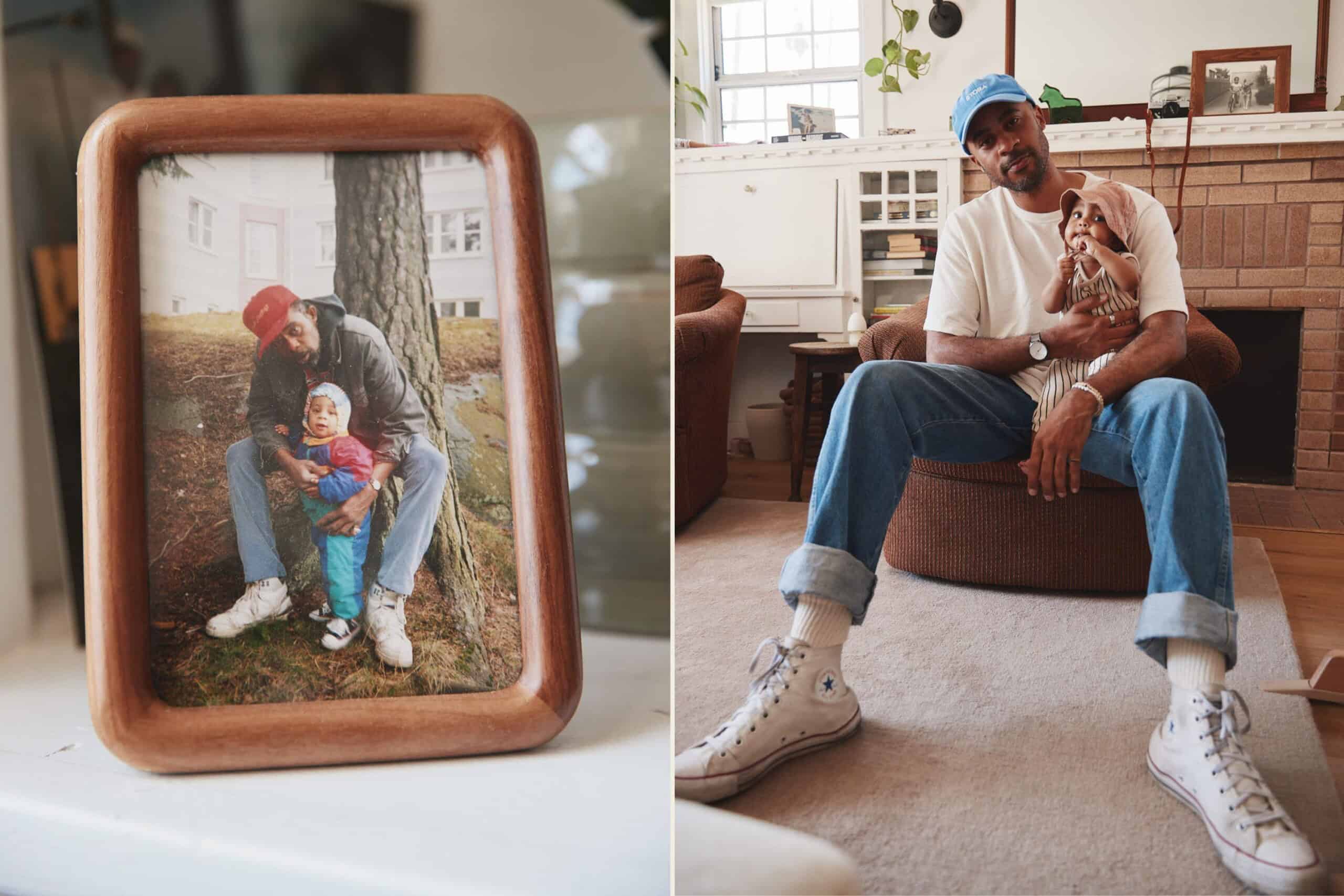
I don’t know how to explain the loneliness I’ve felt since my Pops passed. Our bond was deep, ancestral. Even our fissures were bound by a powerful sort of cultural fabric. I miss his large hands. I still feel his warm palm around my head as a kid, clippers in his other hand, cutting my hair in our unfinished basement. This was my first lesson on male intimacy. A closeness and tenderness contrary to the ways we’re repeatedly conditioned, and a feeling that became increasingly infrequent with age. The only place I recall feeling safe. I miss his laughter, like a salve for sorrow. I miss his thunderous voice floating over Motown classics. And his urging, again and again, that we take care of each other. His death means navigating Black American fatherhood alone.
The yearning I feel to hold your sister is like an insatiable hunger, my stomach ever in knots. I miss rocking her to sleep on my lap and chest, staring into her soulful eyes. I miss the levity and innocence of holding her close. I miss her curls and toes and burgeoning voice. I miss the feeling of my palm cradling her head, as my father did mine—the completion of a tender cycle. I miss our quiet exchanges, whispering devotion like lullabies. I miss the version of myself I was in her presence. Peaceful, exuberant, weightless. But her death, even in devastation, has colored mundanity with magic. All of it is sacred, and it ensures I never take a moment with you for granted.
The longing I feel for both has thrust me into a time loop between past and future. I’m suspended between generations, thinking constantly about the things fathers inherit and the things we impart; about what was given to me, what was withheld, and what I choose to carry forward.
Maybe fatherhood is a bridge. Between the things that shape us and the things we shape. An evergreen opportunity to arch the legacy of fatherhood in my family towards intimacy and steadfastness. Using words to clear a pathway for a tenderness I received only in pockets.
I cannot change my inheritance, a blend of wonder and curses. I cannot change what happened to your sister. I cannot shield you entirely from darkness. But I can decide what kind of papa meets you there. And I can instill in you the confidence to face it bravely.
Tenderness has been my antidote to fear. But fatherhood revealed calluses I did not know I had. Pride, hurt and anger that long lay dormant. Losing Etta exposed more still. And raising you reminds me that I have choices. That one’s inheritance is not their fortune. That every day presents a new opportunity for devotion, starting within.
I choose to use my hurt as a balm to soften the hard hidden edges I built to protect myself. I choose to be grief’s companion—to trust that grief is not my adversary. I choose to let grief do its good work. To mold me into a more present being. To make me a stronger, more grounded, patient and appreciative father. And to open space for you, where joy and grief are kin.
And when part of your world inevitably goes dark, I choose to sit with you at fear’s edge.
Your papa will be here to help you center your breath, adjust your eyes, and find healing in the cosmos. I will wait beside you, beneath a blanket of stars, and together we will become light.
Matthew R. Manning is a Los Angeles-based father, writer, storyteller, and brand strategist who believes storytelling is humanity’s most powerful tool for bridging empathy and connection. See more of his work at MatthewManning.com and at Overture on Substack.
Share this story